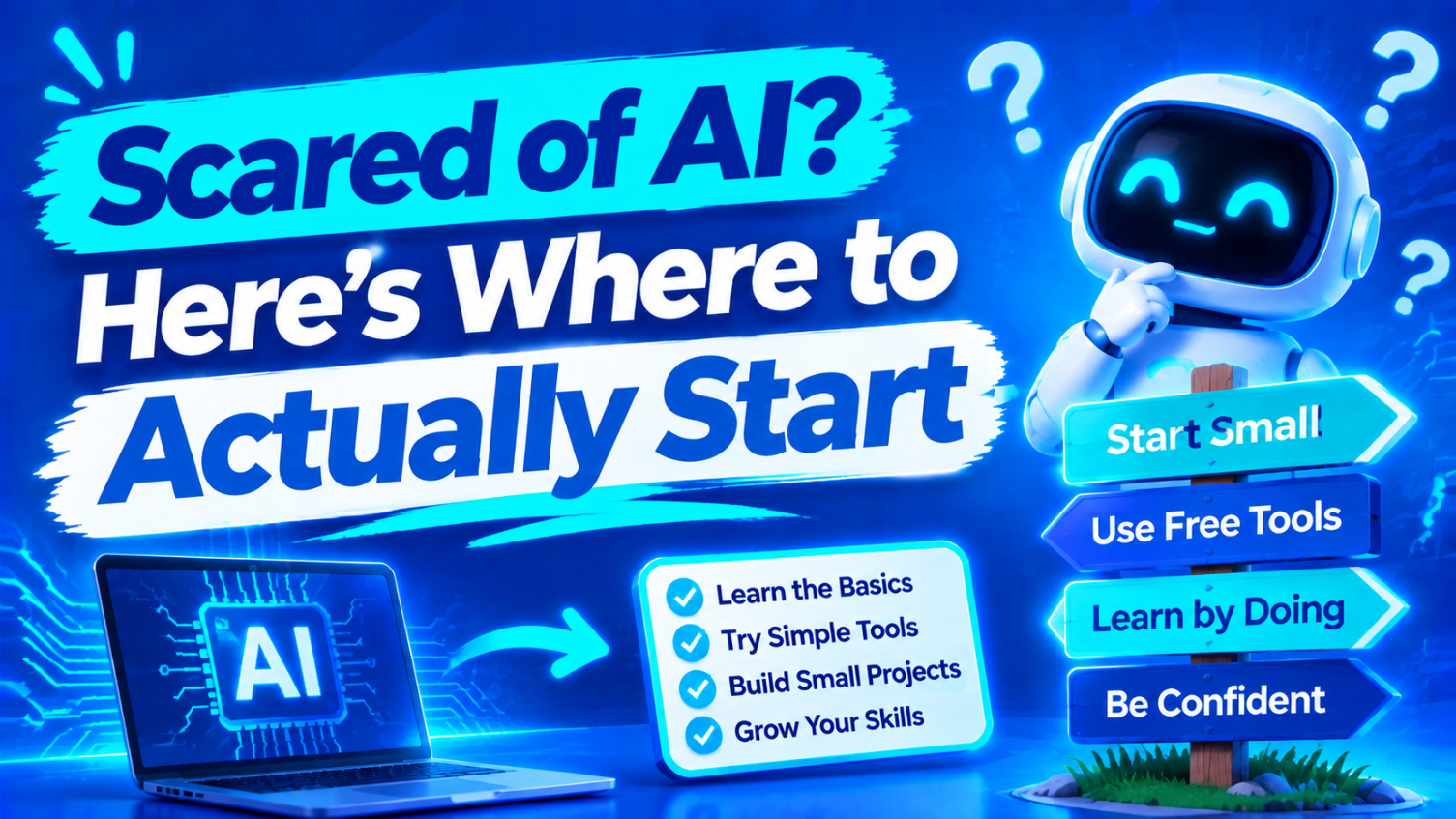
If you have been avoiding AI, you are not being irrational and you are not behind. You are having a reasonable reaction to two years of people shouting at you — half of them promising it will change everything, the other half promising it will take your job.
This page is not a pep talk. It is an attempt to separate the fears worth having from the noise, and then give you something small to do.
“Scared of AI” is usually four different fears
They need different answers, so it is worth knowing which one is yours.
- It will take my job. The most common, and the most reasonable.
- I will look stupid. Everyone else seems to have worked it out and you do not want to ask.
- It will make me worse at my work. A real concern, not a silly one.
- Something larger. Where this all ends, what it does to people, whether anyone is steering.
The first three are the ones you can actually do something about this week. The fourth is a legitimate thing to hold an opinion on, and no blog post is going to resolve it for you.
The job fear, answered straight
Nobody can tell you with confidence what happens to your specific job, and anybody who does — in either direction — is guessing. Forecasts about AI and employment vary enormously depending on who commissioned them, and many come from organizations selling something.
What is observable right now is narrower and more useful. These tools are good at first drafts, summarizing, rewriting, routine formatting and getting past a blank page. They are poor at knowing what the client actually meant, judging what matters, being accountable when something goes wrong, and noticing the thing nobody asked about.
Look at your own week through that lens. Most jobs contain a boring, repetitive portion and a judgement portion. The boring portion is genuinely exposed. The judgement portion is where you actually get paid, and that is the part worth protecting by making more room for it.
Which leads to the only practical conclusion available: the person who understands the tool is in a better position than the person who refused to look at it. Not because of a slogan about adapting, but because they know what it can and cannot do, and can say so.
The “I will look stupid” fear
Nobody is an expert at this. The field is a few years old, the tools change monthly, and most of the confident people online are confident about a product they are affiliated with.
There is also nothing to learn in the way there was with, say, Excel. No formula syntax, no menus to memorise. You type what you want in ordinary words. If the answer is wrong you say “no, I meant this”. That is the whole interface.
The jargon — prompt engineering, tokens, models, agents — is largely people making a simple thing sound difficult. You can ignore all of it and still get value on day one.
The “it will make me lazy” fear
This one deserves more respect than it usually gets. If you hand over all your writing, your writing will get worse. If you stop thinking a problem through because something will produce an answer-shaped object in four seconds, your thinking does suffer.
The way to hold this is simple: use it for the parts of the work you do not want to get better at.
Nobody is trying to become a better writer of invoice reminders, a better formatter of meeting notes, or a better composer of polite declines. Hand those over. The work you actually care about — keep doing that yourself, and use AI to argue with rather than to replace you.
Your first hour
Pick a free tool — ChatGPT, Claude and Gemini all have free tiers — and do three things. Not a course. Three things.
- Make it explain something you already understand well. Ask about your own field. You will immediately see what it gets right and where it is confidently vague. This calibrates your trust better than any article, this one included.
- Give it a boring job you have been avoiding. The awkward email, the notes nobody has typed up. Something real, not a test question.
- Catch it being wrong. Push until you find a mistake. It will not take long. The moment it invents something and you spot it, the spell breaks — and that is when this becomes a tool rather than a magic box.
Step three is the important one. Fear of AI usually rests on a belief that it knows more than you. It does not know anything in the way you do. Our guide on why ChatGPT makes things up explains what is actually going on when it gets things wrong.
What to ignore
- Anyone promising you will save ten hours a week. They are usually selling a course. Treat time-saving claims from sellers as marketing.
- Prompt packs. You do not need a thousand prompts. You need to describe what you want clearly, which you can already do.
- “AI will replace you” as career advice. It is engagement bait and it tells you nothing actionable.
- The pressure to use it for everything. Sometimes the fastest route is typing the sentence yourself.
A reasonable position
You do not have to be excited about this. You do not have to believe it changes everything, and you are allowed to find parts of it genuinely worrying.
What is worth avoiding is the position of having a strong view about a tool you have never opened. Spend an hour. Form your own opinion from the thing itself rather than from people shouting about it. Then use it where it helps and ignore it where it does not — which is, in the end, how you treat every other tool you own.